 As we head into a week of holiday baking and cookie-making, here's one last roundup of seriously nourishing comfort food: A delicious salad for a holiday buffet, lamb burgers, and noodles topped with egg — for breakfast!
Friday, December 10, 2010
10 One-Pot Wonders and Fresh Zucchini Crudo Delicious links for 12.10.2010
10 One-Pot Wonders and Fresh Zucchini Crudo Delicious links for 12.10.2010: "

Oregon man changes his name from Douglas Smith to Captain Awesome
Oregon man changes his name from Douglas Smith to Captain Awesome: "
Inspired by the nickname of a character on the NBC TV show 'Chuck,' Mr. Awesome also now signs his name with a smiley face and two arrows.

London tuition fee protest
London tuition fee protest: "
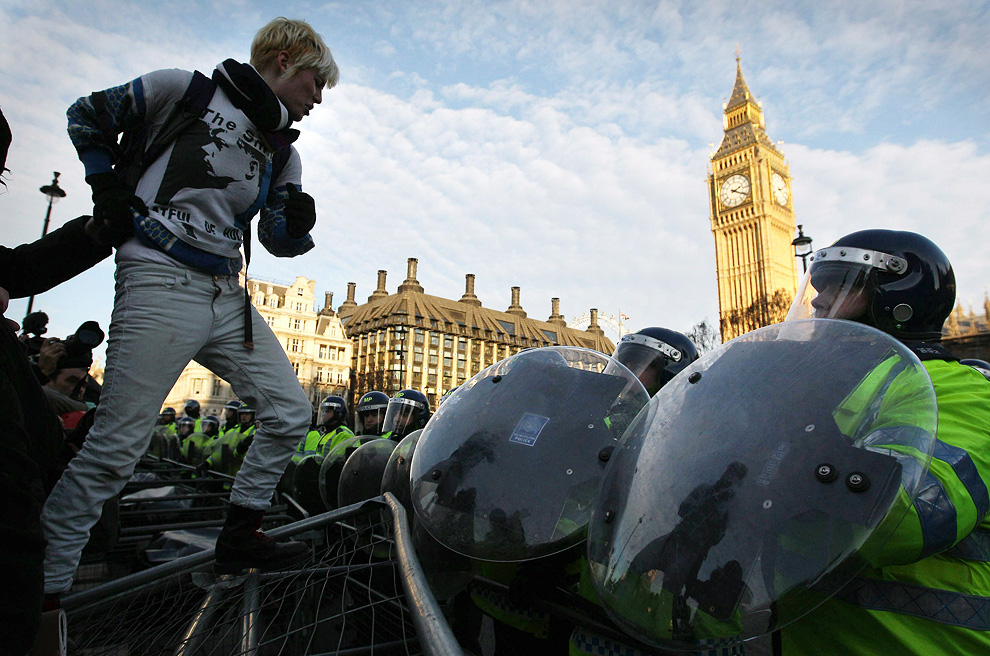
Yesterday, in central London, thousands of students and others gathered to protest as Britain's Parliament met to vote on a proposal to raise university tuition fees significantly - nearly tripling them - as part of a continuing set of austerity programs. During the protest, several clashes took place between police and protesters, resulting in numerous injuries and 43 arrests. Late in the demonstration, a group of protesters attacked the car of Prince Charles and Camilla, Duchess of Cornwall as the couple were inside, being driven to the London Palladium. The car was slightly damaged, the royal couple unharmed, though a bit shaken by the incident. Parliament did end up narrowly approving the measure, and the fee increases are set to take effect in 2012. Collected here are images from London last night. (39 photos total)
Wednesday, December 8, 2010
Kawah Ijen by night
Kawah Ijen by night: "
Photographer Olivier Grunewald has recently made several trips into the sulfur mine in the crater of the Kawah Ijen volcano in East Java, Indonesia, bringing with him equipment to capture surreal images lit by moonlight, torches, and the blue flames of burning molten sulfur. Covered last year in the Big Picture (in daylight), the miners of the 2,600 meter tall (8,660ft) Kawah Ijen volcano trek up to the crater, then down to the shore of a 200-meter-deep crater lake of sulfuric acid, where they retrieve heavy chunks of pure sulfur to carry back to a weighing station. Mr. Grunewald has been kind enough to share with us the following other-worldly photos of these men as they do their hazardous work under the light of the moon. (30 photos total)

Censorship is censorship, especially when it’s the Library of Congress
Censorship is censorship, especially when it’s the Library of Congress: "
 "
"

The Library of Congress has blocked access on all of its computers to Wikileaks. This action was taken, according to the Library of Congress blog, in direct response to a memo from the White House Executive Branch. According to a New York Times article, the White House has since said that it issued no such directives to block Wikileaks in any government agency. I am unconcerned with the “he said, she said” childish finger pointing of the different arms of government. I don’t care who said what to whom in a memo, an email, or in a hallway conversation.
I am, however, gravely concerned that the leading library of the United States has willfully and arbitrarily blocked access to information. Blocking access to information, any information, is censorship. This action is unconscionable.
I condemn the Library of Congress action in every way, and like others I fully reject their attempt at justifications or defenses of their action. There is never a justification for blocking access to information in a library — never.
The Library of Congress’s decision is a violation of the First Amendment and a violation of the American Library Association’s Bill of Rights. Moreover, it is a violation of the professional ethics of librarians to always provide free access to all information. The Librarian of Congress has violated our ethics knowingly. I am horrified.
The documents leaked on Wikileaks have been posted on the free and open web for some time now, and are therefore pieces of open and free information on the web, as is all other information in the United States. These documents are not illegal. So why, pray tell, does anyone have the right to block access to them in a federal government institution?
In this case particularly, access to this information is even more critical to the continued success of an open democracy. The documents contained in the Wikileaks collections often expose the federal government’s dereliction of duty, incompetence, poor judgment, and even criminal actions. Exposing our government’s actions is a matter of concern for every single citizen. Is this not a golden case study for why we need freedom of information in a democracy? Is it not a golden opportunity for the Librarian of Congress to stand firm with his professional ethics, and say “Hell no, I won’t block access to information!” ?
Interestingly, there is already a functional problem with this decision for the Congressional Research Service within the Library of Congress. The CRS researches government and public information to inform lawmakers of current important issues. The CRS will now be unable to access Wikileaks to include the leaked material’s primary content in their reports to Congress. So now Congress won’t know what’s in Wikileaks? Oh yeah, that’s good for democracy.
The Progressive Librarians Guild has called for formal condemnation from the American Library Association. I second that motion. From the PLG’s post:
We call on the American Library Association (ALA) to condemn unequivocally this move by the Library of Congress to actively conspire in preventing access to information in the public interest. Blocking access to this published information is censorship, plain and simple, and supporting sanctions against reading is endorsing abridgment of intellectual freedom. The documentation’s open publication by an agency of the free press, Wikileaks, renders its government classification status irrelevant.
It would seem that someone was more concerned about saving his relationships with politicians than he was about upholding Constitutional rights and his professional ethics. This is a deeply disturbing precedent and an affront to all librarians everywhere.
The Library of Congress should be ashamed of its action of pure censorship, reverse the block immediately, and be censured by the American Library Association for malfeasance. I also encourage President Obama’s administration to get involved in the fray immediately. If Obama is still “committed to creating an unprecedented level of openness in Government” as stated in 2009, then this is a perfect opportunity to re-emphasize that commitment.
Quote Hook
Quote Hook: "
Discover more great design by following Design Milk on Twitter and Facebook!
© 2010 Design Milk Posted by Jaime in Home Furnishings Permalink No comments Tweet This Share on Facebook "
"

Blend Design has created a new coatrack called the Quote Hook that takes the form of a motivational phrase. As the first thing you see when you come home or the last before you leave for the day, the Quote Hook will inspire and remind you to stay positive!


The Quote Hook is currently available in three different phrases: Keep Moving Forward, You Make It Happen, and Live Your Life. Each phrase comes in three color options: white, black, and yellow.
Discover more great design by following Design Milk on Twitter and Facebook!
© 2010 Design Milk Posted by Jaime in Home Furnishings Permalink No comments Tweet This Share on Facebook
Tuesday, December 7, 2010
How Google’s New eBookstore Might Save Indie Booksellers
How Google’s New eBookstore Might Save Indie Booksellers: "


 "
"
Advances in digital bookselling have usually pushed independent bookstores further and further out of the literary game. But Google's new store is dealing them back in. Here’s how.

If you stroll on over to your corner bookstore this week and ask the person behind the counter about Google's new ebookstore, which launches today, you probably won’t be greeted with the kind of teeth-gnashing that has accompanied other digital developments, like Amazon's online bookstore or the advent of proprietary e-readers. Instead, you might actually be greeted with some excitement and delight. That’s because Google is taking a different approach to selling e-books than Amazon or Barnes & Noble. Rather than create a closed system that leaves others out in the cold, Google is actually partnering with independent bookstores to sell its wares--and share the profits.
Google's e-books program will act as much as a distribution system as a retail outlet. You can buy Google’s e-books directly from the company’s ebookstore, if you like. But if you’d rather support your local bookstore, you can buy the exact same books on their site. Rather than holding on to every part of the chain, the way Amazon’s Kindle program does, “we’re building an ecosystem,” Google Books director of product management Scott Dougall tells Fast Company.
There are a few reasons Google is going a different way. The ebookstore emerged from the Google Books program, which didn’t start out as a potential revenue stream. Instead, the company’s book-scanning project was simply a program to help the company fulfill its mission to make all of the world’s information accessible. Since so much information is contained in books, the company wanted to make sure that if you were using Google Search to look for a particular topic, it would be able to point you to books containing information about that topic, in addition to relevant web pages. Then, as Google Books began partnering with publishers and contemplating a program to sell books in addition to just making them searchable, it made a philosophical decision that brick-and-mortar bookstores are critical to the literary ecosystem. “A huge amount of books are bought because people go into a physical bookstore and say, 'Hey, I want this, I want that,'” Google Books engineering director Dan Clancy told an audience at the Computer History Museum last year.
Michael Tucker, president of the American Booksellers Association, which negotiated the deal to distribute Google's e-books through independent bookstores, points to another reason Google is dealing the booksellers in: Google is fundamentally a technology company, not a retail enterprise. And it’s certainly not an expert in the book business. “They recognized that they are not a bookstore,” Tucker tells Fast Company. “They wanted to be able to access [the skills of booksellers].”
Google says it has deals to sell books from almost 4,000 publishers, including all the major houses, and that 'hundreds of thousands' of books will be available for purchase. Google has arranged to get 30% of every book sale, with publishers retaining the remaining 70%. In its deal with the ABA, bookstores that sell Google e-books will get a portion of that 30 percent. Neither Google nor Tucker would divulge the terms of the deal, but Tucker said it was “more generous” than the deal booksellers currently get from Ingram Digital, the other major supplier of e-books to independent bookstores.
Bookstores seem to be cautiously optimistic about the Google program. A person who answered the phone at St. Mark’s Bookshop in New York said, “We’re looking forward to it,” before referring Fast Company to the ABA. “We’re really pleased,” said Mark LaFramboise, a buyer at Washington D.C.’s Politics and Prose. “We’ve been waiting for this for a long time.”
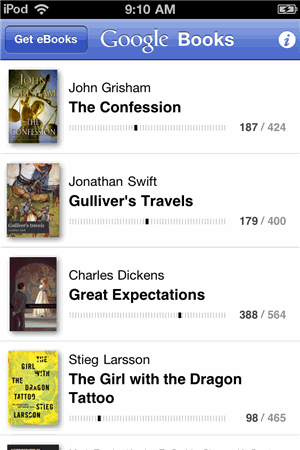 Darin Sennett, director of strategic partnerships at the famous Powell’s book shop in Portland, Oregon, is particularly excited about Google’s technological model. The Kindle, the Nook, and the Sony eReader all use the traditional approach to e-books: They sell DRM-protected files that customers download to devices and which must be read with specific e-reading software. Google, however, is using the cloud. Its e-books will be stored on Google servers, and readers who’ve purchased them will access their books via a browser. Unlike in the Kindle system, where Kindle e-books can only be read on Kindle devices, Google e-books will be able to be read on any device that has a browser. Until now, independent bookstores have been effectively shut out of devices like the iPad and smartphones (which are emerging as many customers’ reading platforms of choice) because the e-books available from other distributors were either not compatible with those devices or the formatting was so clunky as to make them effectively unreadable.
“Kindle and Nook are formidable technologies, but they’re islands,” Sennett tells Fast Company. “There are so many [devices and readers] outside those islands. What Google does is fill the oceans between them.”
Readers who prefer to own their own copies of Google e-books will be able to download them, in either PDF or ePub format. But Google anticipates that most customers use the cloud because of its convenience: They’ll always have access to their books, no matter what device they have with them at any particular time. (On the down side, however, using the cloud requires having an active Internet connection.)
Politics and Prose’s LaFramboise says Google's program gives independent bookstores an effective avenue for staying in the bookselling game as some readers’ preferences shift to digital formats. “When people come to us and say ‘We really love independent bookstores and we want to buy our e-books from you,” now we can say, ‘You can.’”
Subscribe to:
Posts (Atom)